

Blog
The Art of Hand-Pierced Brass: How Moroccan Lighting Is Made

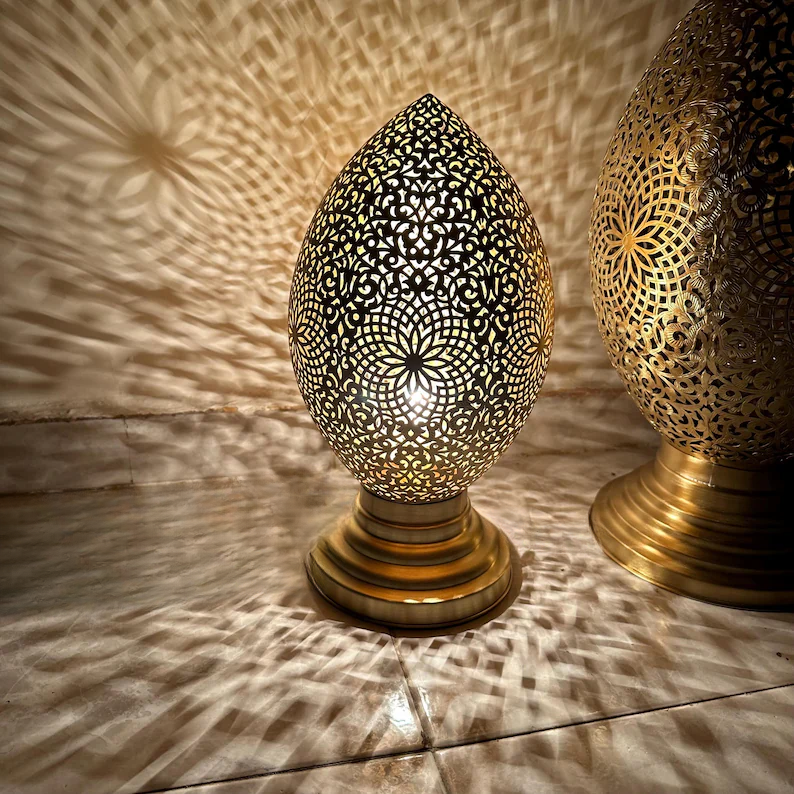
Every hand-pierced brass lamp we sell starts as a flat, unremarkable sheet of brass. So what turns it into a glowing, patterned piece of light? It is the hand-pierced brass technique itself: a slow, entirely manual process. This process is carried out in small workshops across Morocco, largely unchanged for generations.
From sheet to hand-pierced brass shade
First, an artisan marks out the pattern on the brass sheet by hand. This could be a floral mandala, a geometric lattice, or a star motif. Then the sheet is shaped, by hammering or rolling, into the base form of the final piece. That might be a dome, a cylinder, a teardrop, or a flat disc.
The hand-piercing process
This is the slowest and most defining step. Using small hand chisels and punches, the artisan perforates the brass one cut-out at a time, following the marked pattern. In fact, a single ceiling light or pendant can involve several hours of this perforation work alone. It is this handwork, not a laser or stamping machine, that produces the slightly organic, irregular edges you can feel when you run a finger along the pattern.
Why every piece is slightly different
Because the pattern is cut by hand rather than machine-stamped, no two lamps are ever perfectly identical, even within the same design. Small variations in spacing or depth are normal. In fact, they are part of what distinguishes a handcrafted piece from a mass-produced one. When lit, these same irregularities are what give the projected shadows their organic, almost hand-drawn quality on the wall or ceiling.
Finishing the brass
Once the piercing is complete, the piece is cleaned, smoothed, and finished in one of four tones: Gold, Cooper, Silver, or Black. The finish is applied and sealed to slow down natural tarnishing. Even so, brass will always develop a little character over time. Most owners find this adds to the piece rather than detracting from it.
Why handmade matters here
A hand-pierced lamp takes meaningfully longer to produce than a machine-cut equivalent. But the payoff is in the light it casts: denser, warmer, and more textured shadow patterns. A laser-cut or mass-produced fixture rarely reproduces this convincingly. Brass itself has been used in decorative metalwork for millennia, as this overview of brass as a material explains. You can see the full range of hand-pierced brass pieces, from chandeliers and pendants to wall lights, in our shop.